
The Gift Arrives
The Gift Arrives
“This column, from the first Philadelphia, the biblical Rabbat-Amman, has endured for over 2,000 years. We are pleased that, for centuries into the future, it will join the great archaeological collections of this Museum for all to witness as a treasure and a symbol for enduring freedom and independence which we commemorate today." [8]
-Ambassador Abdullah Amin Salah (1976)
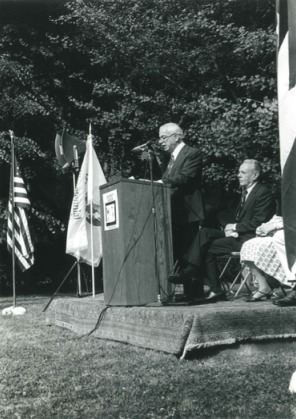
Abdullah Amin Salah, who was appointed as the Jordanian Ambassador to the United States on June 6, 1973, and who later in the 1980s served as Ambassador to the United Nations, gave the formal speech to mark the placement of the column at the Penn Museum on June 17, 1976 [9]. Being the first state to give a diplomatic gift to Philadelphia in celebration of the Bicentennial, this dedication ceremony received significant media attention.
But who or what was the official recipient of this column? The United States government, the city of Philadelphia, the corporation that organized the bicentennial festivities, or the university that ultimately hosted it? The answer to this question is unclear, as the following discussion will aim to show.
Consider this backstory: After Crown Prince Hassan of Jordan had publicly announced the gift, and before it had even arrived in America, the city of Philadelphia had to decide where to place the column and who to make responsible for it [10]. A subcommittee of Philadelphia ’76 Inc. was entrusted to decide where all gifts would go. The subcommittee was made up of Robert Montgomery Scott, Harry Takiff, and Augustus Baxter [11]. In a letter sent on September 10, 1975 to various museums throughout Philadelphia, including “the Philadelphia Museum of Art [and] the University Museum,”, the subcommittee sought institutions interested in providing a home for the column [12]. On September 26, 1975, the Associate Director of the Penn Museum wrote to the subcommittee saying that the Penn Museum would be “pleased to give this large column a fitting and permanent home in the enclosed courtyard of the Museum” [13]. Hence the University of Pennsylvania officially received the column at the ceremony over which the Jordanian ambassador presided.
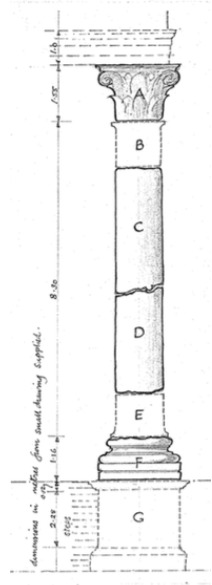
Yet there was even more to the story than that. On November 13, 1975, after the column arrived in Philadelphia, Peter Shepheard, Dean of the Graduate School of Fine Arts at the University, inspected and sketched the column at Philadelphia’s Pier 36. Shepheard pointed out that the Corinthian column was heavily eroded and broken in four pieces, and that two pieces of the column were missing [14]. In a memorandum later sent by Titus Hewryk on January 30, 1976, he wrote, “if we attempt to reconstruct the entire column, the cost would be prohibitive” [15]. It appears that the Penn Museum agreed to house this Column without fully understanding its condition.
Generally, when a museum receives the offer of donation, it must take an item into careful consideration before accepting. A museum must consider the cost it will take to restore, preserve, and display the donation [16]. It is important that the museum can do the donation justice. With this Jordanian column, however, it appears that the Penn Museum did not do this assessment before offering to accommodate it.
The column sat in the Stoner Courtyard of the Penn Museum with a sign explaining its origin until 2000. At this point the Museum began construction on a new wing near the courtyard with the Jordanian column [17]. It was at then that the column left the museum courtyard and moved to the University of Pennsylvania's Engineering Quad, a few blocks away. Penn Museum Archivist, Alessandro Pezzati, speculated in an interview in November 2014 that the construction was an opportunity to transfer responsibility for the column to the Office of the Curator, which manages the University-wide art collection. [18] Since then the column has been in a kind of limbo; Professor Peter Struck from the Department of Classics calls it ownerless [19].
In September, 2004, the Column was again moved “from an area immediately south of Bennett Hall on the University of Pennsylvania Campus to a small grassy island north of the 1958 Wing of the Chemistry Complex” [20] The reason for this move is unknown. In approximately 2008, the sign in front of the column disappeared [21]. No signage has been added to the Column since then. According to the Office of the Curator, which currently has jurisdiction over the column, Penn Facilities is in charge of all signage upkeep and replacement, even for sculptures [22].
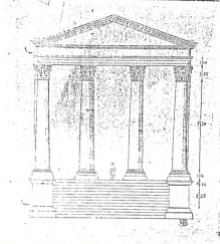
The column has had a fascinating history since its arrival in Philadelphia nearly forty years ago. But one should not forget the two thousand years when it was “living” in ancient Philadelphia, now Amman. The Column “was adorning the façade of the…Monumental Gate of the City” and it “was built at the beginning of the magnificent staircase which was leading from the lower City to the upper City or acropolis” [23]. We know the exact location from which this Corinthian column came; it was not a random column from a random location, and this makes its cultural and historical significance and potential value to researchers all the greater.
Having been under the jurisdiction of the City of Philadelphia, then of the Penn Museum, and finally of the University of Pennsylvania's Office of the Curator, the column has lacked a stable home. It is hard to pin down who is currently looking out for it. Even the University Facilities website has the location of the Column mislabeled. They erroneously claim that the column is from a different ancient Philadelphia—this one in Turkey [24]. This biblical Philadelphia (meaning "city of brotherly love"), now called Alaşehir, was part of the Roman empire at the time of the column's creation two millennia ago [25]. Adding to this confusion, a new interest in the column seems to be awakening at the Penn Museum. Dr. Richard Zettler, Curator of the Near Eastern section at the Museum, says he would like to see the column back in the Penn Museum, where it can receive proper care [26]. Just two months ago, the Penn Museum requested permission from the Office of the Curator to do a conservation assessment of the column, a request that the curator’s office approved [27].