Wave Forms
Dublin Core
Title
Wave Forms
Subject
Public Art and Iconic Symbols
Description
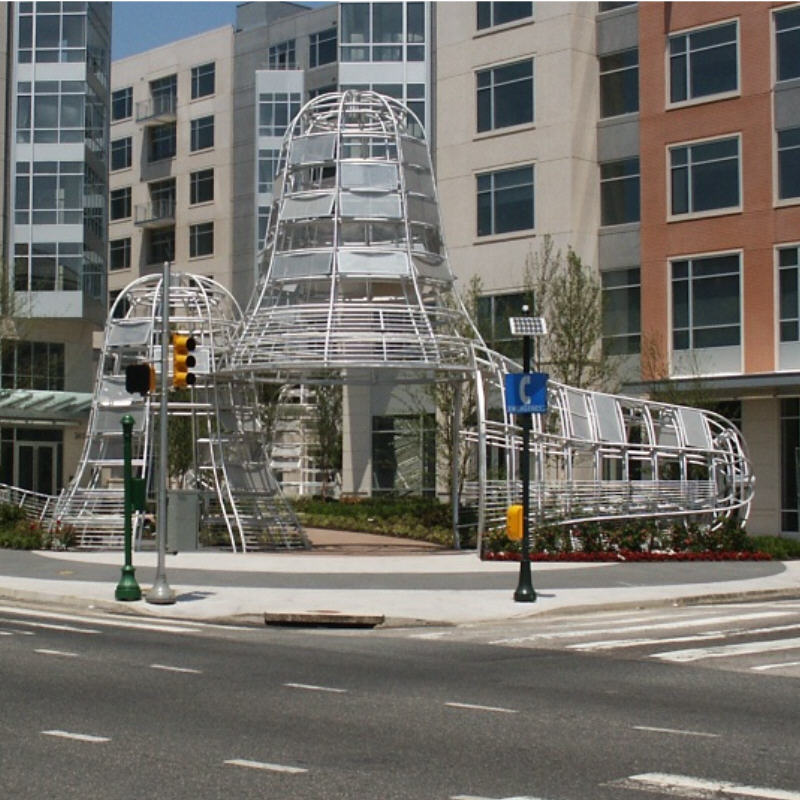
Wave Forms, 2007, Aluminum

Dennis Oppenheim (American)
“By taking the visual configuration found in sound waves to structure the plaza garden, I could detour from the more obvious associations brought forth by the Liberty Bell, Philadelphia’s most famous image. By increasing the scale of the bells to approximate architecture, I was able to disturb the association of the bell as ‘object’ to bell as ‘dwelling’ ” - Oppenheim (1938-2011)
At the intersection of Chestnut and 34th stands Dennis Oppenheim’s Wave Forms. The entire structure is composed of six aluminum bells that are each 20 feet and lay adjacent to the Domus apartment complex that neighbors the University of Pennsylvania campus. The bells rise as high as 34 feet and viewers are able to walk through and under the transparent aluminum structure.
At the time of its 2007 installation, the construction of the apartment complex had just concluded and Oppenheim’s work had been included near the property as part of Philadelphia’s Redevelopment Authority Public “Percent for Art” Program which stipulates that the site of development must include public art that is site-specific.

Beginninging 1959, the program requires that the public art commissions must be worth at least one percent of the total construction development budget. Philadelphia is the first city in the United States to create this commission and development relationship policy. In the past half century, the city has become the home to one of the largest public
Public art has played an interesting role not only in Philadelphia, but throughout cities in the United States.In fact, the first public art programs in the country began with the New Deal, which initiated the Treasury Department's Section of Painting and Sculpture in 1934. This section comissioned artists who had won competitions to decorate federal buildings with their works in order to raise morale and create jobs during the Great Depression.
Oppenheim designed Wave Formswith the intention of producing an alternate visual representation of the iconic Liberty Bell that is located just a few miles away. By distorting the symbol’s traditional appearance, Oppenheim’s public structure inspires commentary and thoughtful discourse about freedom and expression in the United States.

Dennis Oppenheim (American)
“By taking the visual configuration found in sound waves to structure the plaza garden, I could detour from the more obvious associations brought forth by the Liberty Bell, Philadelphia’s most famous image. By increasing the scale of the bells to approximate architecture, I was able to disturb the association of the bell as ‘object’ to bell as ‘dwelling’ ” - Oppenheim (1938-2011)
At the intersection of Chestnut and 34th stands Dennis Oppenheim’s Wave Forms. The entire structure is composed of six aluminum bells that are each 20 feet and lay adjacent to the Domus apartment complex that neighbors the University of Pennsylvania campus. The bells rise as high as 34 feet and viewers are able to walk through and under the transparent aluminum structure.
At the time of its 2007 installation, the construction of the apartment complex had just concluded and Oppenheim’s work had been included near the property as part of Philadelphia’s Redevelopment Authority Public “Percent for Art” Program which stipulates that the site of development must include public art that is site-specific.
Beginninging 1959, the program requires that the public art commissions must be worth at least one percent of the total construction development budget. Philadelphia is the first city in the United States to create this commission and development relationship policy. In the past half century, the city has become the home to one of the largest public
art collections in the world.
Public art has played an interesting role not only in Philadelphia, but throughout cities in the United States.In fact, the first public art programs in the country began with the New Deal, which initiated the Treasury Department's Section of Painting and Sculpture in 1934. This section comissioned artists who had won competitions to decorate federal buildings with their works in order to raise morale and create jobs during the Great Depression.
Oppenheim designed Wave Formswith the intention of producing an alternate visual representation of the iconic Liberty Bell that is located just a few miles away. By distorting the symbol’s traditional appearance, Oppenheim’s public structure inspires commentary and thoughtful discourse about freedom and expression in the United States.
Dennis Oppenheim (1938-2011) was originally from Washington State and was a photographer in addition to being a sculpture artist. He was an artist of the conceptualism movement that developed in the 1960s and 1970s. The conceptualism movement emphasized thought process and priortized the idea behind a project over the finished art work. Pictured below, his works were known to be grandiose and sometimes controversial as he would make strong political and moral statements through his public art works.
Creator
Dennis Oppenheim
Source
This work is a 20 foot bell shape made out of aluminum. It is a visualization of the sound waves that would come out of the Liberty Bell. Essentially, it is a recreation of the iconic symbol.
Date
2007
Type
Public Sculpture
Coverage
Intersection of 34th and Chestnut Street
References
Medium
Aluminum
Citation
Dennis Oppenheim, “Wave Forms,” Art at Penn, accessed October 23, 2026, https://pennds.org/arth503640/items/show/7.