Peace Symbol
Dublin Core
Title
Description
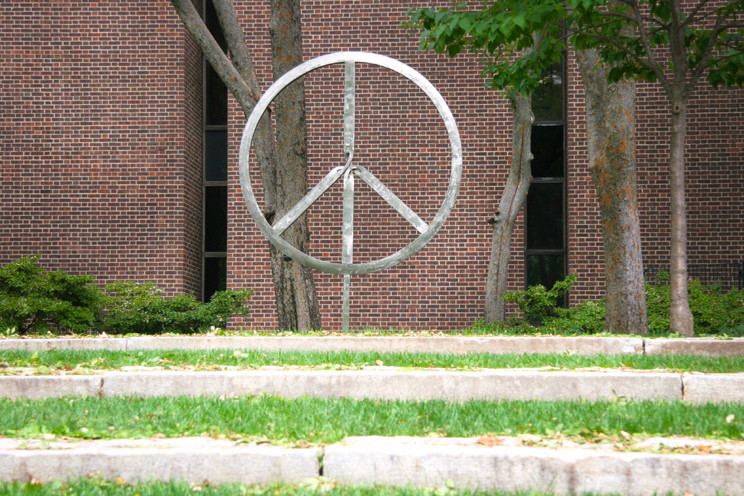
Peace Symbol by Robert Engman and students, 1967

In 1967, Robert Engman was advisor to eight fine arts students who collaborated together to begin constructing the Peace Symbol. Raised upon a pole to be more visible, the memorial of the victims of the Vietnam War was constructed out of steel. Like universities all over the country, the University of Pennsylvania was deeply entrenched in protests and demonstrations against the Vietnam War. In fact, the year this was built was at the height of protests at the university, as students found out about the school’s own policies and contributions to chemical warfare.
Unlike some of the other public art pieces at Penn which were often created as a result of city ordinance laws, everything about the Peace Symbol was deeply symbolic and political. A Daily Pennsylvanian news article about the construction of the peace memorial was on the front page. Every article except one on that page was about the Vietnam War. Robert Engman himself stated that they decided on a peace symbol because it “specifically related to the Vietnam War”. During this time, there was a lot of friction between the student body and the school administration as a result of the war, and the construction of the Peace Symbol became inevitably tied to the political events of both the country and the university. While planning and construction had started in 1967, the students were still running into problems with university financial support two years later, which inevitably added more fuel to the fire with everything else that was happening.
During the Vietnam War, Dow Chemicals was a company which supplied napalm for the war. Every year, they had representatives visit universities for recruitment. On November 8 of 1967, a massive sit-in demonstration occurred right outside the Dow recruitment office for seven hours to protest the company’s presence.  The students did not obstruct the office, but their presence made any recruitment attempt tense and emotional. Not only did the civil disobedience demonstration disrupt Dow Chemicals’ recruitment, students eventually flooded the CIA recruitment office as well, forcing the recruiter to leave early.
During the entirety of 1967, the controversial ‘Spice Rack’ contract came under continuous attack from students and staff. The ICR (Institute for Cooperative Research) was accused of researching chemical warfare for the government in the Vietnam War. Much of the research was non-publishable, leading to rumors of secret policies at the university concerning chemical warfare for years afterwards. Regardless of whether there were secret agreements between the university and the government in researching chemical warfare, it reflected the fact that the war touched everything in students’ lives. The fact that just by going to Penn, students might have become implicitly involved with the Vietnam War regardless of how they personally felt made the construction of a memorial all that more important.
The political context of the Peace Symbol faded over the years, but its presence as a political symbol has always remained. Multiple political protests have used the memorial for protests and demonstrations. In 1996, a woman by the name of Kathy Change self-immolated in front of the memorial as an effort to gain more awareness for her social cause. While the context of the Peace Symbol has changed over the years, it will continue to be a platform of protest and political awareness for the university.
Creator
Date
Coverage
References
http://www.library.upenn.edu/docs/kislak/dp/1969/1969_11_03.pdf
http://www.archives.upenn.edu/histy/features/intrntnl/crises/vn_war.html
http://www.archives.upenn.edu/faids/upt/upt50/murray_ds.html
http://dparchives.library.upenn.edu/cgi-bin/pennsylvania?a=d&d=tdp19671102-01.2.4#
http://dparchives.library.upenn.edu/cgi-bin/pennsylvania?a=d&d=tdp19670331-01.2.22&srpos=9&e=-------en-20--1--txt-txIN-spice+rack------#