Six Triangles
Dublin Core
Title
Six Triangles
Description
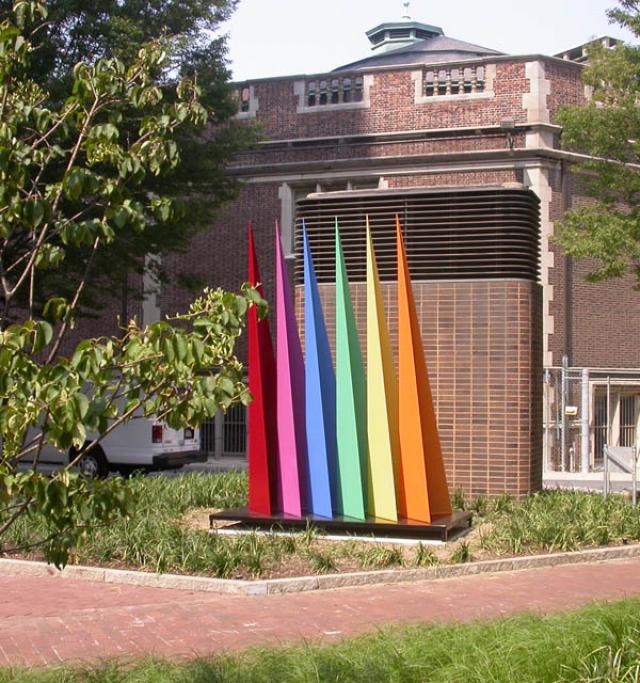
Six Triangles by Ephraim Peleg, 1979
While sitting in the tree -lined breezeway between Guardian Drive and Curie Boulevard, idle individuals take lunch or make phone calls. Six Triangles punctuates the space with a friendly palette and unassuming nature. At face value the rainbow color-scheme of Six Triangles seems to represent support and pride for the LGBTQ community. Such an adoption would be a very politically progressive choice for a University and medical school, as Six Triangles was created in 1979. However, the inspiration for these red, pink, blue, green, yellow, and orange triangles that stand today near The University of Pennsylvania’s School of Nursing is much more wrought with heartache. Ephraim Peleg, born in Poland in 1936, is a survivor of the holocaust and lost both his parents to the tragedy. He relocated to Israel to avoid the catastrophic events taking place in Europe and, after relocating, began to study art. He attributes the repetition in his sculptures, especially of six forms, to each represent one million individuals that were lost due to the holocaust. Unlike many sculptures dedicated to the holocaust, Peleg’s differ in their bright hues. Peleg suggests that he does this to engage all ages with the work by using an attractive color scheme. Through this use of color, these works are also able to transcend the heaviness and sadness of Peleg’s experience. The brilliant hue of painted steel is sharp and strong when paired with the steep geometric triangles. This artwork is memorial to something very tragic, but it is not mourning. The birth of Six Triangles comes from a desire to resist, survive, and persevere.
Creator
Date
1979
References
Medium
Orange, yellow, green, blue, purple, and red painted steel
Citation
Ephraim Peleg, “Six Triangles,” Art at Penn, accessed October 23, 2026, https://pennds.org/arth503640/items/show/10.